
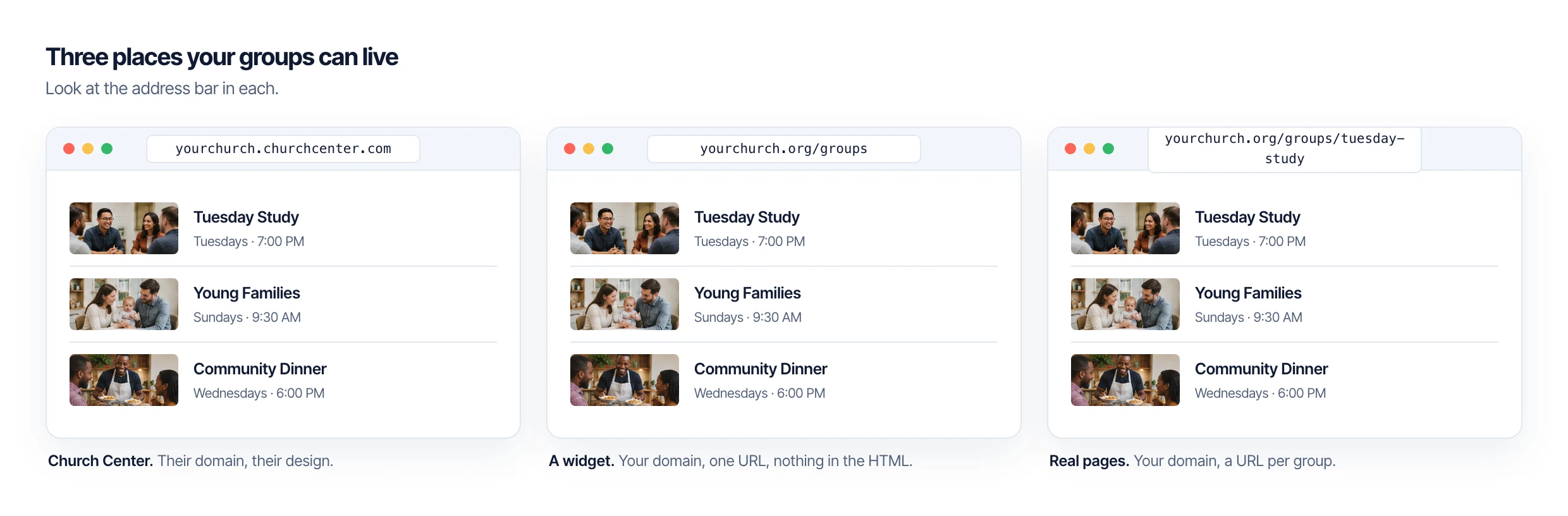
There are three realistic ways to show your Planning Center groups to someone who isn't in your church yet, and they fail in different places. Here's an honest read on each.
Church Center
Planning Center gives you Church Center at no extra cost, it takes about ten minutes, and it handles joining properly. If your groups change constantly and nobody on staff wants to think about a website, this is a defensible answer and plenty of churches should stop here.
What you give up is the address. Church Center lives on a Planning Center domain, so the traffic, the design, and the search visibility belong to that page rather than to your site. A visitor who came to read about your church gets handed to something that doesn't look like your church.
An embedded widget
Widgets work anywhere. Squarespace, Wix, Nucleus, a site your cousin built in 2019, it doesn't matter. You paste a snippet and groups appear, styled roughly like your site, with no plugin to maintain. For a church on a platform with no good plugin story, that convenience is real.
The cost shows up in the HTML. Widgets inject groups into the page after it loads, so the version your server sends has no groups in it, and individual groups usually have no URL of their own. You get one page about groups instead of one page per group, and clicking through often sends the visitor to a church management system on someone else's domain.
Your own website
The third option is publishing groups as actual pages on your own site, which is what PCO Bridge does. Each published group becomes a post at your own address, rendered by your server, in your theme, with archives by group type, meeting day, and campus.
This costs more setup than pasting a snippet, and it needs a site you can install a plugin on or a developer who can call an API. That's the tradeoff, and it's a real one.
The question that usually decides it
Ask what happens when somebody searches for a small group in your town at eleven at night, having never heard of you.
With Church Center, they might find the Planning Center page if it ranks. With a widget, there's no page to find. With group pages on your own domain, they land on your website, read about the group in your words, and see the rest of your church around it.
If nobody is discovering your church through search, that scenario doesn't matter much and the cheap options are fine. If it's how people find you, the address is the whole game.
Joining still happens in Church Center
Worth being clear about this: even with PCO Bridge, the final join hands off to Church Center. Planning Center owns membership, and we don't try to take that over. What moves to your site is the discovery, the browsing, the reading, the deciding.
PCO Bridge is in beta and applications are open to churches, developers, and agencies.